
“Sixteen go in, but only fifteen come out.”
Who knew that the place from where my ancestors hail was also the home thousands of years before that to Neolithic inhabitants that buried their dead in chambered cairns where I, some nearly five millennia later, would be threatened with the possibility of going for a visit but potentially not coming out?
“Okay, Garr,” I said to my tour guide, shortening his name from Garry after only knowing him for a couple hours. “Let’s go on and leave.”
But I wasn’t going to leave, mainly because Garry had worked some magic to even get us a spot to visit this site that is booked up solid for weeks to come.
At several stops along my travels, I’ve seen folks walking around with their own personal tour guide. I’ve heard that hiring a local guide is hands down the best way to experience a place, but I never could justify the cost. That is until I got to Orkney. There it had to be done.
The largest island — known to the residents simply as Mainland — has so many incredible things to see, but it really is quite necessary to have a car to get you around to all of them. So it was with that in mind — I mean, come on, there’s no way I’m renting a car and driving on the wrong side of the road… nevermind that they’re all manual transmission — that I got on the internet and started looking for guided tours.
My initial thought was to just do something similar to which I’ve done at Stonehenge and the two in Ireland, but then the more I thought about it, I felt like I could absolutely justify splurging here, at this place that directly holds some of my roots.
An hour or two later, I settled on Garry of Orkney Travel, and he later let me know that I emailed him just in time as someone else messaged him literally minutes after I did asking if he had last-minute availability on Thursday.
It. Was. So. Worth. It.
The day before my guided tour, I took the bus across the island from Stromness to Kirkwall where my Airbnb for the next two nights was located, and I knew just from that bus trip that I was going to enjoy the next day if only for the scenery alone (and I may have said a prayer or two to any travel god that would listen to please keep the weather at bay).
After settling in and starting a load of laundry — this is why I alternate between hotels and Airbnbs — I headed out for dinner and ended up at Harbour Fry, a local fish and chips spot.
Anyone that knows me knows that I hate places where you order at a counter. I absolutely hate them. I loathe them. I don’t like the pressure of having to read the menu that’s on the wall, usually in a font too small for my glasses-needing eyes. I don’t like the pressure of having people waiting behind you. I don’t like it. Not one bit.
So I walked right on by Harbour Fry the first time I passed, only to find that the other restaurant I was interested in was packed.
No problem. This whole thing has been all about stepping out of so many of my comfort zones. Might as well do it yet again. Even if begrudgingly.
“Yeah what’ll you be havin?” the bearded man at the register asks after I haltingly step up.
Somehow, incredibly, I don’t even see the big-ass (sorry for the expletive, but it’s the only way I know to drive home my point about how large this menu was) menu on the wall behind the counter.
“Umm…”
Oh god, just keep going Taylor. Say something.
“I don’t really know how this works.”
OH GOD.
“What do you want to eat?”
I’m tempted to run away, but I squeak out something about fish and chips and a Diet Coke, and I have to stop myself from flying over to the table in the very back when he says they’ll bring it out to me.
But it was all so worth is as the fish was one of the best pieces of fried fish I’ve ever had in my life.
It was so good that I decided right then I was coming back the next night, and I observed carefully how the locals would come in and order so I would be more prepared. I cannot confirm or deny that I stood in front of the bathroom mirror later that night, reciting my line — “I’ll have the fish supper, please” … “the fish supper, yeah?” … “Can I get the fish supper?” — over and over.
Anyways, you’re not here for tales of my social anxiety, so let’s get to the good stuff the next day.
My private seven-hour tour with Garry began that morning at the absolutely beautiful St. Magnus Cathedral, and it was obvious from the jump that Garry was going to be incredible.
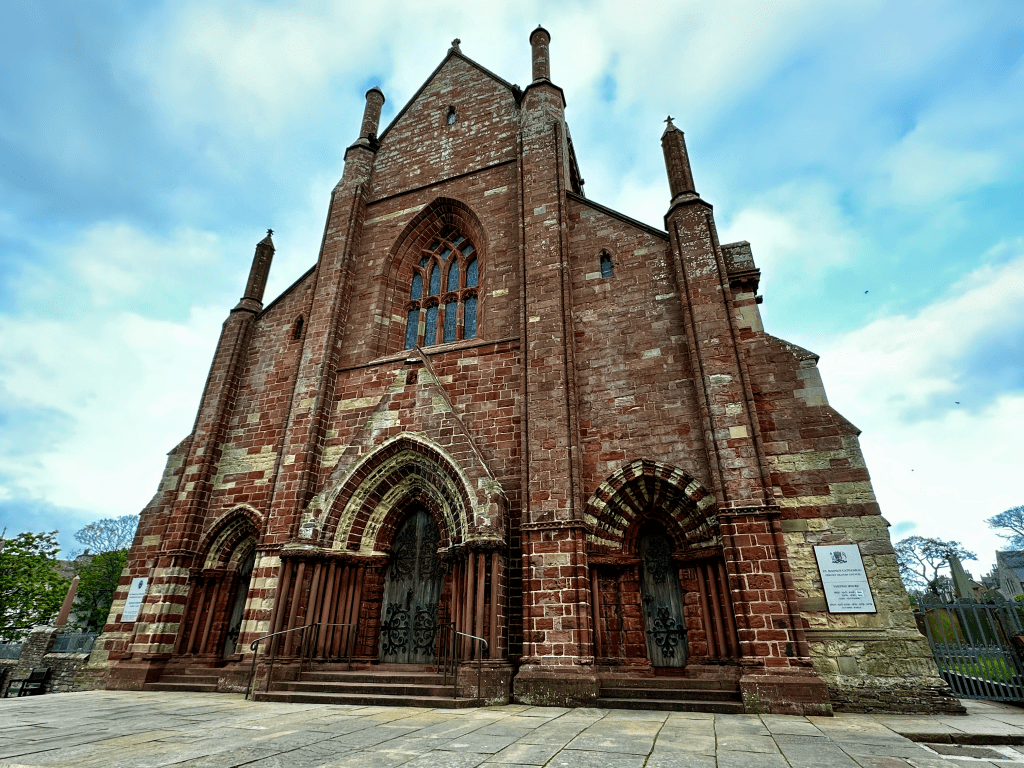
There are just details that you get when on a tour that you don’t get otherwise. He pointed out to me that the grand building was built in several phases, noting the changes in the architecture that existed inside. He showed me how the shoreline used to be much closer to the church, with the columns on the front of the structure indeed showing the wear and tear that came from being right next to the sea in what is a hostile windy environment.
All day I just was beyond appreciative for his incredible insight, and it was especially impressive because of how much he knew about sites that stretched from that way-back Neolithic period to as recently as World War II.
After the cathedral, he took me to the first grand view we’d have of the day, up to the top of a hill where a radar site used to be during the aforementioned war, and it provided a sweeping look of the Scapa Flow — the second-largest sheltered harbor in the world behind only Sydney Harbor — and other nearby islands in the archipelago (I love you autocorrect).
Upon descending back down, Garry explained that we were next going to visit the Maeshowe chambered cairn, an addition to our itinerary that he was able to luckily book that morning.
Lucky is an understatement when you consider the amazing experience I was about to have.
It was while we were waiting in the visitor center to catch the shuttle out to the site that a jolly lady who worked there and got on great with Garry looks at me and says that sixteen people go in but only fifteen come out.
I half-believed her.
And we all burst out laughing when I told my new friend Garr that it was time to leave.
It was even more believable when we arrived at the mound.
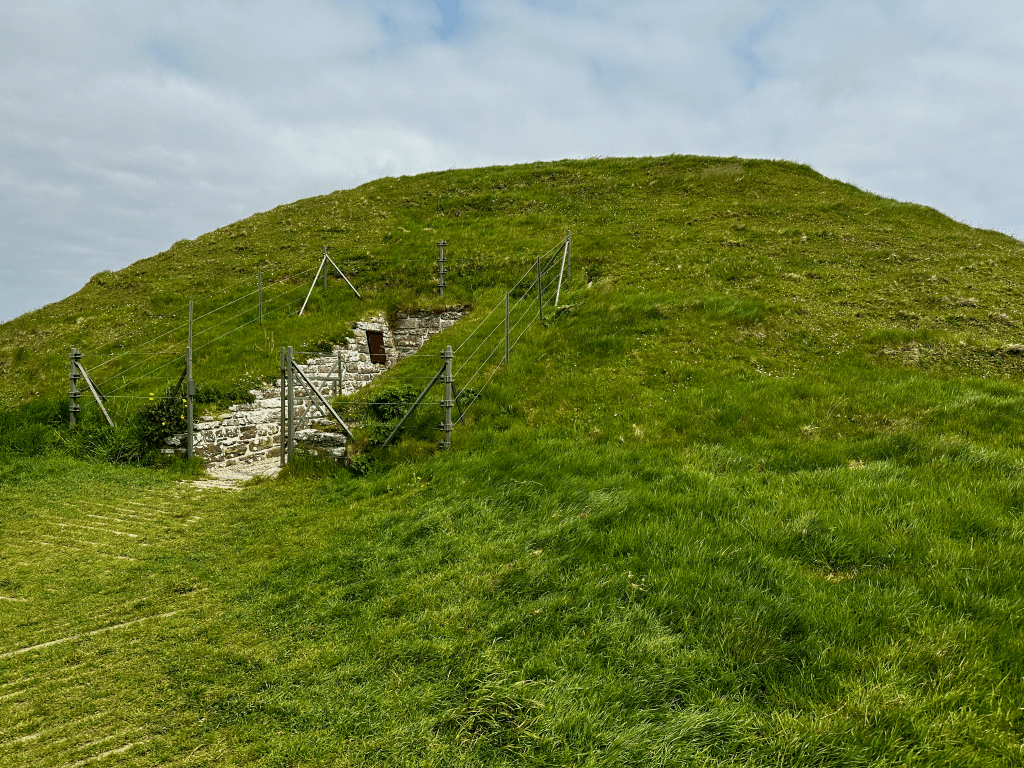
The entryway is small at only three-feet high, forcing visitors to crouch down to get inside for a length of 30 feet, but it’s well worth the cramped corridor when you pop into the small but impressive main chamber.
Other chambers jut off from the perfect circle that’s made of ginormous solid slabs of stone, and pondering how they even moved the blocks there isn’t the most amazing thing to consider because there’s also the fact that the entrance is aligned perfectly so that on the Winter Solstice, the sun shines down the shaft and hits the back wall.
I came to just one conclusion: aliens.
But seriously, how amazing is that? Archeologists date the structure back to around 2800 BC, and these folks were so incredible that not only did they have a way to get the huge pieces of rock there from miles away but then also to build it in such a way to hold such spiritual significance.
Impressive.
The site also features Norse runic inscriptions on the wall — more than thirty which is the largest single number of them anywhere in the world — which would have been done after the Vikings raided the place sometime in the 12th century.
I wasn’t going to have some Neolithic spiritual force suck me into one of the other side chambers, so I made sure I was one of the first ones out to catch the bus to head back to the visitor center where Garry was waiting to take me to the next place.
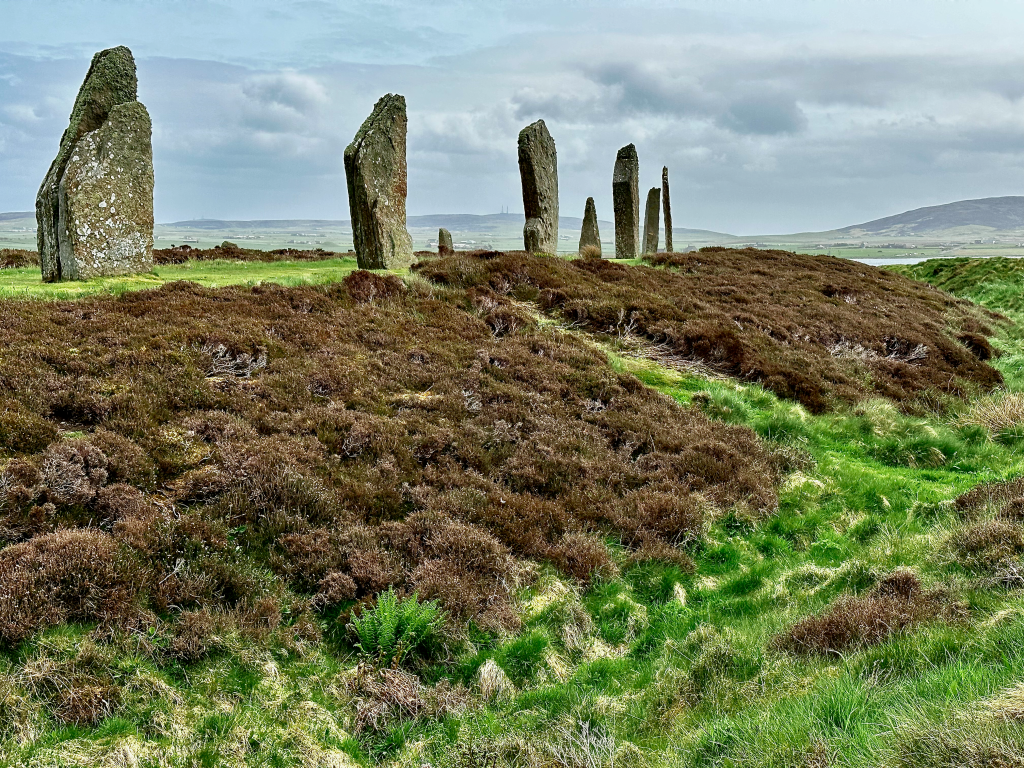
The first of two stone circles we would see, the Standing Stones of Stenness was our subsequent stop, and this place was special for multiple reasons. First off, unlike Stonehenge or even the next circle we would visit, you can walk right up to the stones, and it is also from this place that you get an incredible perspective of the Neolithic features around you. If you face in one direction, directly behind you is the Maeshowe tombs. Between there and Stenness is the Barnhouse Stone which is also directly in line with the Winter Solstice. Ahead of you is the Ring of Brodgar with another newly-discovered, apparently very special and unique site in between, and off in the distance is the Pompeii of Orkney, the Skara Brae.
It was so easy to gaze out across this area dotted with only a couple modern homesteads and imagine what it must have been like thousands of years ago.
I used to stand on top of Winstead Hill in Franklin and look down towards the center of town and imagine what it must have been like on the evening of the Battle of Franklin in the Civil War.
That was like looking back mere moments in time comparatively.
The Ring of Brodgar was more complete, and while it not be as ornate as Stonehenge, it was equally impressive in my mind, especially the ditch that they would have dug out around the site, keeping in mind that they didn’t have great tools with which to do so and would have hit bedrock after only a few inches.
Speaking of Stonehenge, one of the cool things about having Garry showing me around was how thought-provoking him being there proved to be. For example, after he shared with me that it was believed that Stenness could potentially be the first such circle anywhere, it made me wonder if maybe as these people spread south and evolved, they also became more ambitious, more advanced, and thus the more ornate nature of the circle at Stonehenge.
From Brodgar, we headed to Skara Brae, and when I tell you this was one of the coolest things I’ve ever seen, I mean it was REALLY one of the coolest things I’ve ever seen.
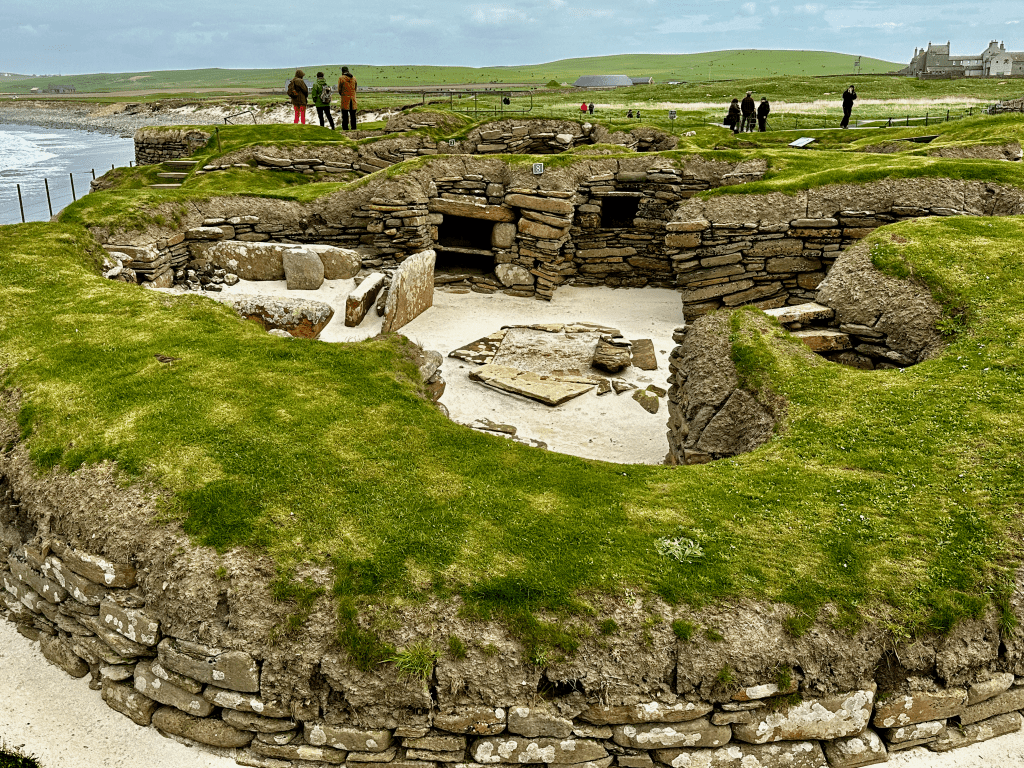
Nearly perfectly preserved until a storm in the mid-1800s washed away a dune and revealed it, Skara Brae was a sunken settlement, built into the ground and mounds of organic waste such as animal bone and other items.
When first discovered, the site contained 10 connected homes, and as you stand above it, you can absolutely picture how it all fits together. Everything remains so remarkably in tact that it’s easy to see where the beds would have been, the hearths in the middle of each house, the shelving units in the back of each one. You can even still see their incredible system of drainage that they used, carrying their sewage out to the sea.
JUST. INCREDIBLE. Truly.
Seeing as Garry had grabbed a bite while I was on the tour at Maeshowe and I wasn’t about to waste any of our time pausing for a meal, that gave my guide time for more extra things, and he took us next to an amazing series of cliffs that more than made up for whatever I missed out on Ireland.
They can have their Irish cliffs. These were cliffs my predecessors may have seen.
The wind was really blowing and the waves were amazing, and the closest thing I’ve ever seen to that was when we were on Cape Cod for Tropical Storm Danny back in the 90s. And that’s only because there were some rocks there and the waves crashed high on them and it was cool.
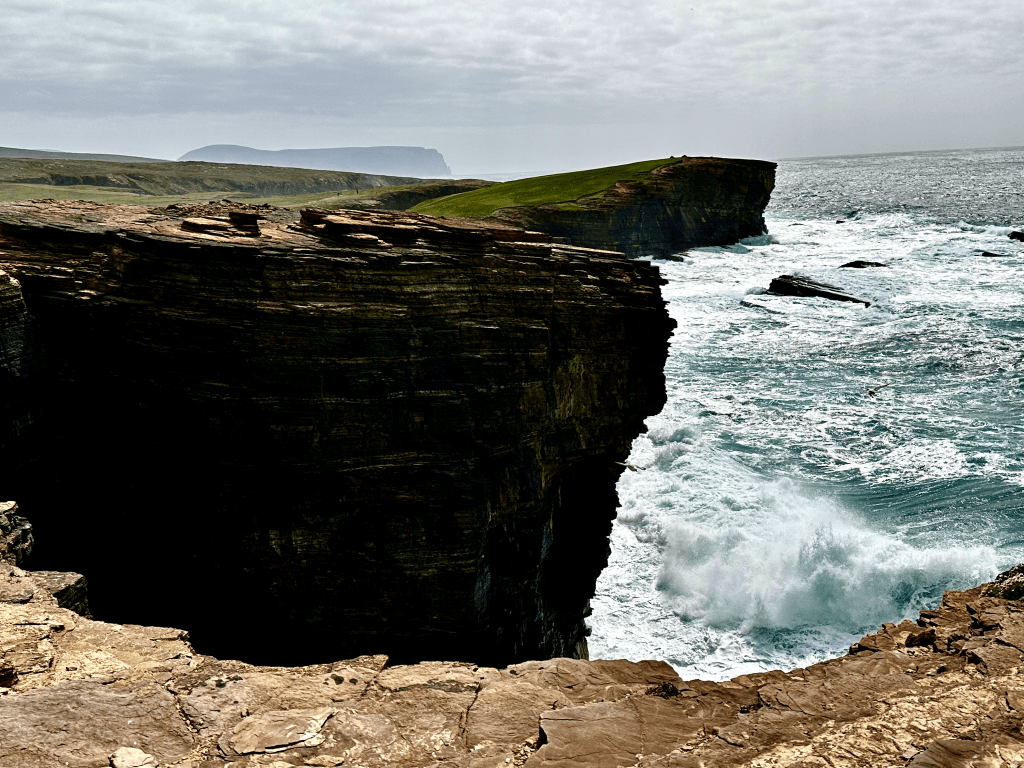
But these were seriously high rocks and seriously high waves.
From there, we headed to the locations I had seen mentioned for some of the names that popped up on Ancestry. Some listed Orphir and others Hobbister, so I thought these were two different places, but Garry explain that Orphir is more like a smaller region on the island while Hobbister is more of a specific location.
“So this is now getting into Orphir,” Garry said.
The hair on my arms stood up on end and for the first time that day I was speechless. I couldn’t even mutter something about it being amazing or impressive.
The scenery, yes, it was beautiful with rolling hills all around, but it was just the thought that someone who may have played a role in my being a person walked around this place that really caused me to be emotional.
“And this is Hobbister.”
He took a turn clearly down someone’s driveway and took off towards an area on his map that was more specific than you’d find on Apple or Google Maps.
If I were my father, I would have gotten out and walked around and probably gone into the person’s house to ask them some questions, but I am not my father and so I was perfectly content just driving through, especially since I knew we were going to go a short bit up the road to a bird sanctuary that is technically in the Hobbister area too.
I think Garry could tell that this was a moment for me, and he stayed in the car when we got the wildlife refuge while I got out and just walked around, looking back towards the area we had just been.
My Morning Jacket’s Circuital ends like this:
Well anyway you cut it / We’re just spinning around / Out on the circuit / Over the hallowed ground / Out on the circuit / Over the hallowed ground / Ending up in the same place / That we started out / Right back in the same place / Right back in the same place / That we started out
I never knew that I’d be able to apply this literally, or at least not anymore so than going back to Franklin to walk on the patch of grass where the battlefield folks destroyed my childhood home (do I sound bitter?).
What an experience, and I can’t encourage you strongly enough to both a) visit Orkney and b) seek out your ancestry. Even if it’s only back a few generations, please do it. You won’t be upset.
After visiting a couple other sites, my time with Garry was winding down, and he had one last surprise for me.
Whatever fancy service he was using back at Hobbister, he also used to find one last site after I pointed out that Ancestry put my 10th great grandfather’s birthplace as Dykeside, Outertown, Orkney, Scotland.
He zoomed in to Outertown, found a Dykeside, and then tapped on a site that was listed simply as Fletts and was marked as ruins.
If William Flett wasn’t in that specific building, he had to have strong relations to someone who did, and Garry was determined to get me there.
Outertown is just on the outskirts of Stromness, as the name suggests, which is where my ferry back to mainland Scotland was leaving from on Friday, so Garry said he’d have his dad pick me up to take me back and we’d stop by that site first.
How incredibly nice!
Garry’s dad was a hoot, and he was also extremely gracious to me. “I guess I’m a little bit more Scottish,” he chuckled after the 72nd time I said “I’m sorry?” after not being able to understand something he said.
We arrived and just like I feared after viewing the location on Google Maps, the road ended and became someone’s driveway, but just like the day before, there we went, unbothered by the property owner as we continued onward with a view of indeed some ruins in the distance.
Finally the driveway ended, getting us as close as possible, but well within visual range. The hair stood up again, and it was Garry’s dad that I had to convince that we needn’t get out and walk up to the remains of the house. Again, I was perfectly content just viewing it from this intrusive but still polite distance.
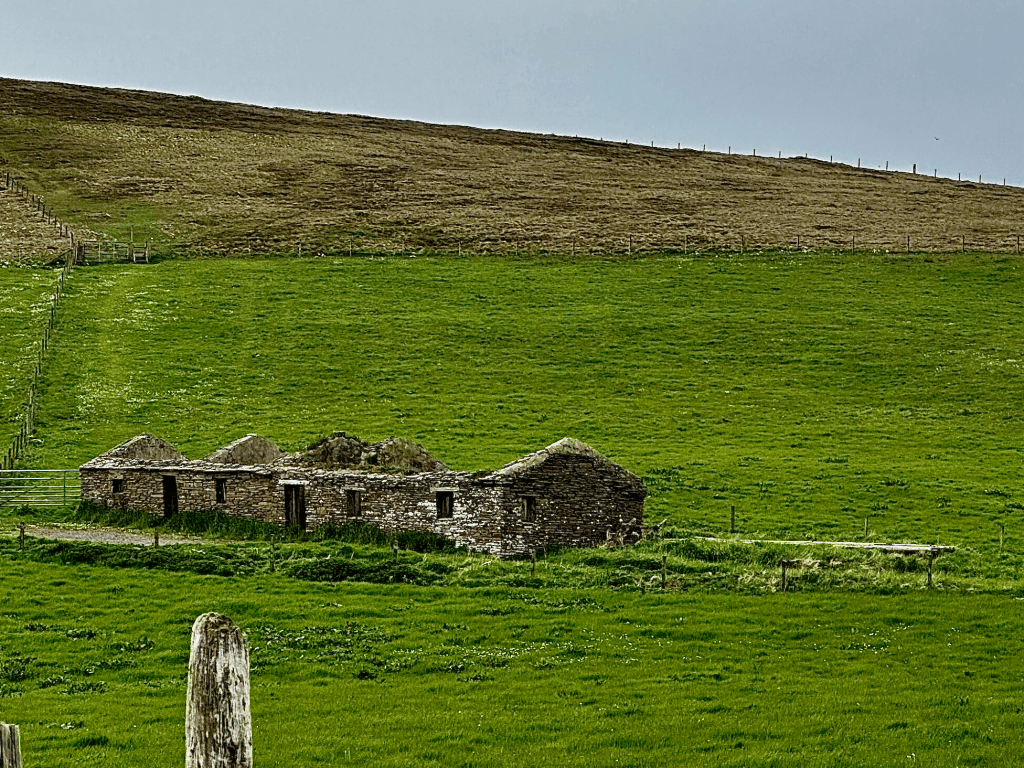
I thanked him over and over the short ride back down to Stromness and one more time when we arrived back at the ferry terminal, where I boarded the boat and enjoyed the ride back. Yes, I gazed upon the cliffs as we passed them, just as stunning as on Tuesday if not more so shrouded in fog as they were, but I also couldn’t help but look back, reflecting on my time in Orkney.
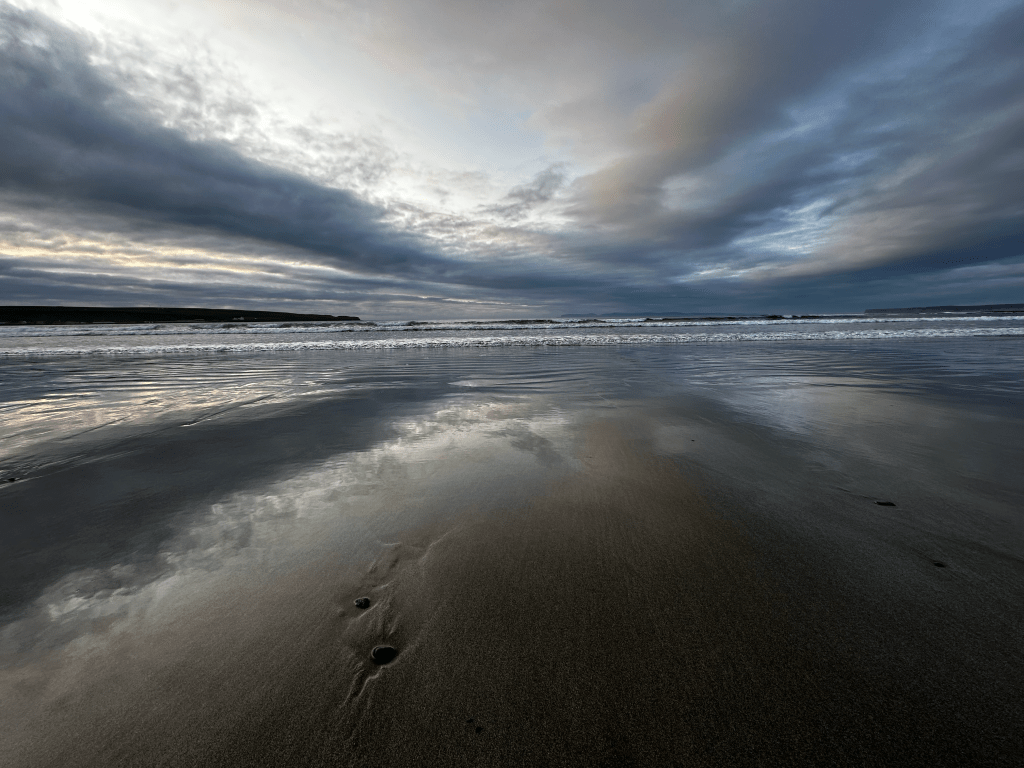
With the ferry arriving in Thurso after 1800, I decided to just spend the night there again, and that’s why I was still reflecting after dinner as I walked down to the sea to look out at my ancestral home one more time. It was a stroll of solitude along the beach, with not another soul in sight in the day’s long-lasting light as it approached 2100 and was still plenty bright as I looked out across Thurso Bay and to the Orkneys in the distance.
In that moment, a lyric came to mind from Chris Robinson & The New Earth Mud’s If You See California in which he sings “there is a place that is close to me / a place made of mountain and sea.”
While Orcadians might call them hills and they might not be wooded and rugged in a traditional sense, they’d qualify as mountains in some parts such as back in Alabama and the weather conditions at times could certainly qualify as rugged if not also the geography (though at the cliffs it certainly is), and so this line struck me.
There is indeed is a place that a close to me that is made of mountain and sea.
And when you consider my father’s love of the mountains and my mother’s adoration of the sea, being a descendant of those who started in such a place makes all the sense in the world.
I’m glad I was one of the 15 that made it out so I can get home to tell them about it.
 Rails to Ride